Feng Y, McFarland DM, Shao M, Yu J, Jiang H. Vortex-induced vibration and wake modulation of a circular cylinder subjected to harmonic cross-flow perturbations. Ocean Engineering, 2026, 362: 126516.
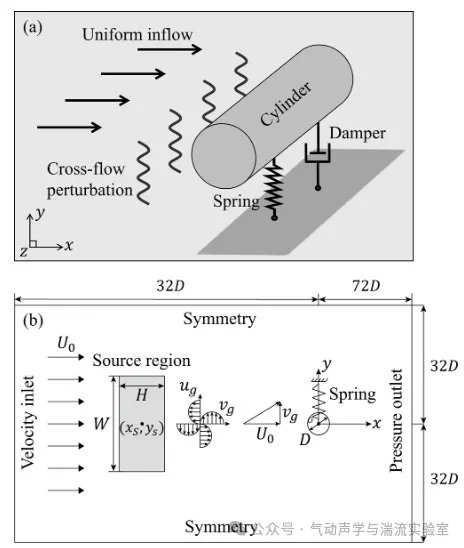
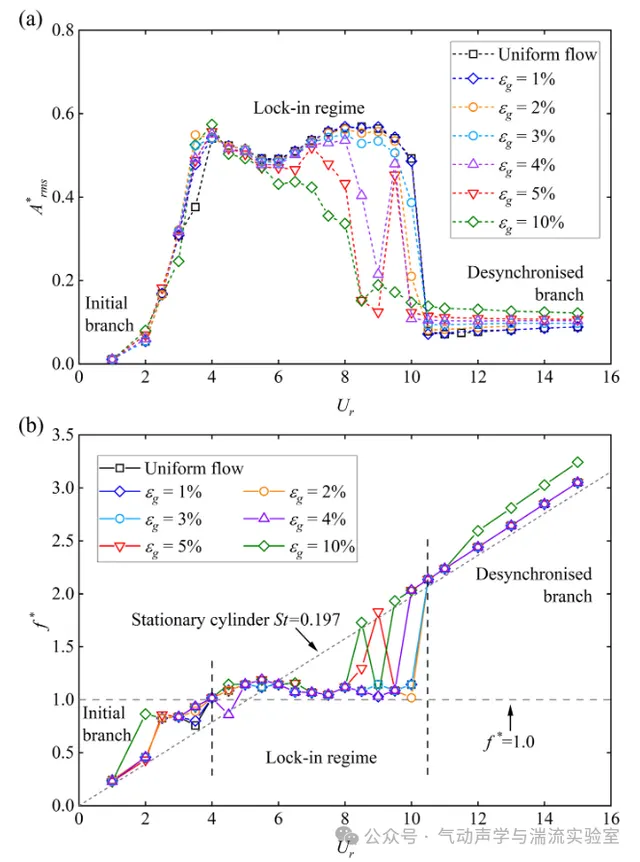
本文采用动量源计算框架,参数化研究圆柱在横向谐波扰动下的涡激振动与尾迹演化。扰动强度为自由来流速度的 1%–10%,约化速度从 1.0 扫描至 15.0。研究从振幅、水动力、相位动态及尾迹演化等方面分析不同约化速度区间内的响应。扰动强度的作用随区间显著变化:锁定前区间内,扰动增大振幅并触发尾迹由 2S 向 2P 模式转变;在所给文本缺失的特定条件下发生完全同步,所有测试扰动强度下均保持稳定振幅和 2P 脱涡模式。锁定区间内,结构振动略受抑制,但响应频率仍保持锁定。向失同步过渡时,内禀脱涡与外部扰动竞争使主锁定状态提前终止,形成低振幅分支,且扰动强度越高,外部主导作用越明显。失同步区间内,扰动增强尾迹动力学,并放大脱涡频率处的结构响应。研究阐明了横向扰动对圆柱涡激振动的多重作用,为海洋工程结构疲劳评估及振动控制提供参考。(所给文本中约化速度符号及完全同步条件缺失,待补原文公式。)
Employing a momentum-source computational framework, this study parametrically investigates the vortex-induced vibration (VIV) and wake evolution of a circular cylinder subjected to harmonic cross-flow perturbations with intensities ranging from 1% to 10% of the freestream velocity. The reduced velocity () is swept from 1.0 to 15.0. The perturbation-modulated response across different reduced velocity regimes is analyzed regarding vibration amplitude, hydrodynamic forces, phase dynamics, and wake evolution. The results indicate that the impact of perturbation intensity varies significantly across different reduced velocity regimes. Within the pre-lock-in regime, the perturbation amplifies the vibration amplitude and triggers a wake transition from 2S to 2P patterns. At [value missing in supplied text], full synchronization occurs. Under all tested perturbation intensities, the response maintains robust vibration amplitudes and a stable 2P shedding mode. Within the lock-in regime, although the structural vibration undergoes slight suppression, the response frequency remains firmly locked. In the transition towards desynchronization, the competition between intrinsic shedding and extrinsic perturbation forces an early termination of the primary lock-in state, leading to a low-amplitude branch. This extrinsic dominance becomes increasingly pronounced at higher perturbation intensities. In the desynchronized regime, the perturbation energizes the wake dynamics and amplifies the structural response at the vortex shedding frequency. These findings clarify the multifaceted role of cross-flow perturbations in the VIV of cylindrical structures, providing valuable insights for the fatigue assessment and VIV control of marine engineering systems. [The reduced-velocity symbol was also missing from the supplied text.]